Technical Readout
Weapons & Armour
M41A PULSE RIFLE
A Marine's best friend is his rifle.
- Anonymous Marine
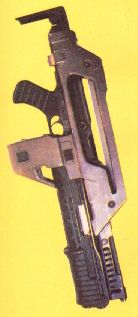
The Colt M41A is a 10mm pulse-action automatic rifle, now adopted as
the standard personal weapon of the US Colonial Marine Corps. The M41
has an over-and-under configuration also comprising a 30mm pump-action grenade
launcher. A spring loaded retractable stock allows it to be used either in a
Carbine format (with stock retracted) or as a rifle, with the stock extended
for greater stability when firing from the shoulder.
The M41 employs the standard US M309 10mm x 24 round. This
ammunition is caseless and High Explosive tipped with light armour piercing
capability. It is designed to penetrate personal armour, exploding just after
impact to inflict the maximum internal damage to a target. Due to the
efficiency of the propellant charge the round is nearly all warhead, making it
very compact overall. The standard M41 ammunition clip will hold up to
100 M309 rounds in an 'N' bend conveyor, which feeds the rounds mechanically
into the breech. However, in practice the clips are only filled to 95% in
order to reduce the autoloaders tendency to jam.
The M41 uses electronic pulse action to fire, controlled directly
from the trigger. The weapon can be set to selective, burst or full automatic
fire by a select switch, the latter option allowing a high rate of fire up to
the weapon's full cyclic rate of 1000rpm. An LED display situated just below
the receiver indicates the ammo remaining in the clip.
The underslung 30mm grenade launcher uses pump action to load the breech
from the five round capacity internal feed. Once loaded, the launcher is
primed to fire from the trigger. This means that the weapon's conventional fire
facility is immobilised whilst the launcher is primed, although the operator
can override this by pressing the select switch fully down. The Grenade
launcher usually employs the M40 fragmentation round as standard, but
HEAP (High Explosive Armour Piercing), White Phosphorous Incendiary and
Hexachlorine Smoke ammunition is available.
The M41 is a robust weapon, fully sealed against corrosion and dirt,
yet easy to disassemble and maintain. The optical electronics are hardened
against EMP and radiation, and the weapon is perfectly usable in a vacuum
(although it is not sufficiently stabilised or recoil dampened for free-fall
combat operations).
M56 SMART GUN
"You know the funniest thing about the M56? Yeah, it was too freakin'
accurate, man! When you checked out the bodycount after a heavy firefight, you
could tell which ones' bin hit by Smart Guns; cuz they'd all have a single
hole burned straight through 'em. No grouping, nothing: just a single, neat
hole. That freaked some of the guys out, and after that they kept the tracking
switched off ... they wanted t'hose that thang, man!"
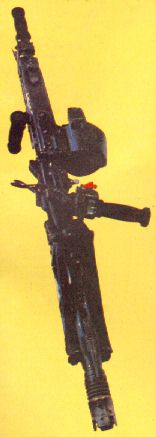
The M56 'Smart Gun' is the US Colonial Marine Corps' standard Heavy
Automatic squad support weapon. Designed to provide heavy infantry support up
to 1500 metres, the Smart Gun has proven a rugged and reliable state-
of-the-art weapon, now employed in a variety of combat theatres and
environments.
The M56 is essentially a 5 KiloWatt gas-dynamic Laser powered by an
array of Liquid Metallic Suspension batteries. The beam itself is emitted by a
fast-discharge monopolar generator which produces a high energy pulse of one-
one hundredth second duration in the invisible light spectrum. When focused,
this pulse instantaneously superheats the target area; creating an explosive
effect capable of penetrating light armour. Beam performance is related to a
number of factors, including the target's ablative properties, atmospheric
quality and obscuration. Yet field testing has shown that countermeasures (such
as smoke or suspended particle clouds) do not significantly degrade the fire
from this powerful weapon.
A Smart Gun operator has the option of setting the weapon to fire
short or full bursts up to it's maximum cyclic rate of 1200 ppm. Because it is
a beam weapon, the gun operator experiences no recoil or muzzle climb upon
firing. However, early versions of the M56 produced a characteristic
muzzle flash; caused as the beam superheated the air directly in front of the
barrel. All current service models now incorporate a flash suppressor,
although this only partially masks the effect.
When in combat, the M56 is actually 'worn' by it's operator. The
operator wears a micromesh armoured combat harness to which the battery packs
attach. The M56 is then connected to the harness by an articulated
dolly; a sophisticated microhydraulic cantilever, which is fully gyrostabilised
and self-steering. The dolly is flexible enough for the weapon to be fired from
the hip whilst standing, kneeling and in crouch positions; or from the shoulder
when prone.
The M56 is not configured like a normal small-arm rifle, having a
series of balanced hand-holds and grips instead of a conventional stock. Since
the weapon is self-stabilised on the harness, these hand-holds are required
merely to aim rather than lift the gun.
The most notable feature of the Smart Gun is the motion tracker
mounted parallel with the barrel, set to monitor a 30 degree cone in front of
the weapon. When the weapon is set to 'Smart' mode it becomes slaved to the
motion tracker and will 'lock on' to the highest priority moving target, as
determined by the operator. The hydraulic dolly will then steer the gun barrel
so as to boresight the target precisely. In effect, this allows the operator to
fire accurately from the hip without having to sight the gun directly. However,
the detector can be jammed or spoofed by decoys, multiple targets and
'friendlies' moving into the detection cone. It therefore requires a well
trained operator to discriminate targets correctly in order to employ the gun's
'Smart' abilities to the optimum. In reality, the gun is only as 'Smart' as
it's operator.
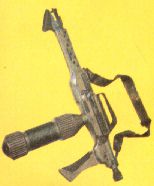
M240 FLAMETHROWER
The M240 is a lightweight, carbine-format flamethrower designed for
use in close combat at the squad and fireteam level. Using pressurised, ultra-
thickened Napthal gel as a base and ignited by the nozzle burner, the
M240 can shoot flame at targets up to 25 metres. Once a target has been
hit the gel will stick and continue to burn for approximately one minute. With
sufficient fuel in a standard fuel reservoir for 20 'bursts' the M240 is
surely one of the most fearsome weapons in the Marine inventory, and has proven
especially useful in close combat and xenomorph culling operations. However, it
is unpopular with many of its operators because of the tendency of the fuel
reservoir to rupture violently when hit by shrapnel or small arms fire.
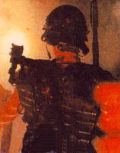
ARMOUR AND BATTLEDRESS
Standard marine issue battledress is of lightweight, rigid Carbon
Fibre/Venlar composite armour and helmet worn over a thermal dissipating
disruptive pattern uniform. Based on the French Armed Forces' Cuirasse de
Combat, the US M3 pattern personal armour can withstand the impact
of most light small-arms fire and slow or deflect many military calibre
weapons; as well as being semi-ablative against lasers.

Areas covered by standard Marine combat armour include the shoulders
and torso down to the groin, whilst rigid shin guards and knee armour protect
the lower legs. The chest/torso assembly also incorporates pouches and slings
in its' design for the wearer's ammo and field kit as well as straps and
webbing for carrying standard field packs. A high-powered halogen lamp is
mounted on the armour's left shoulder bracket for operations in low visibility
where white-light is required and can be unclipped for use as a hand torch. The
assembly also contains the Marine's personal data-link transmitter which
constantly relays bio-readouts, video and radio data back to the battle
management displays at his Command and Operations centre.
The Marine M10 pattern ballistic helmet incorporates a number of
devices, including the side mounted tactical camera which transmits video
images via the data-link back to the Command centre. Audio pickups and
receivers built in to the helmet link all team personnel with each other
and their commanders, allowing for greater command and control. The
helmet is also equipped with a passive Infra-Red sight which can be
flipped down over the left eye for operations in low visibility.
Typed and HTMLed by
Damien
Burke, taken from the Dark Horse comic, Aliens: volume 2, number 1 (July
1992 - ISSN 977 0961 409020). Original author: not stated in comic, but is
probably Lee Brimmicombe-Wood.
Could these weapons truly exist, or was it just fiction?